The top sites for verifying news or any misleading information are independent fact-checking organizations that investigate claims, viral stories, rumors, and political statements using transparent methods, original sources, and corrections when needed. Many adhere to the International Fact-Checking Network (IFCN) Code of Principles, a global standard for nonpartisanship, transparency, and accuracy (over 170 organizations worldwide are verified signatories).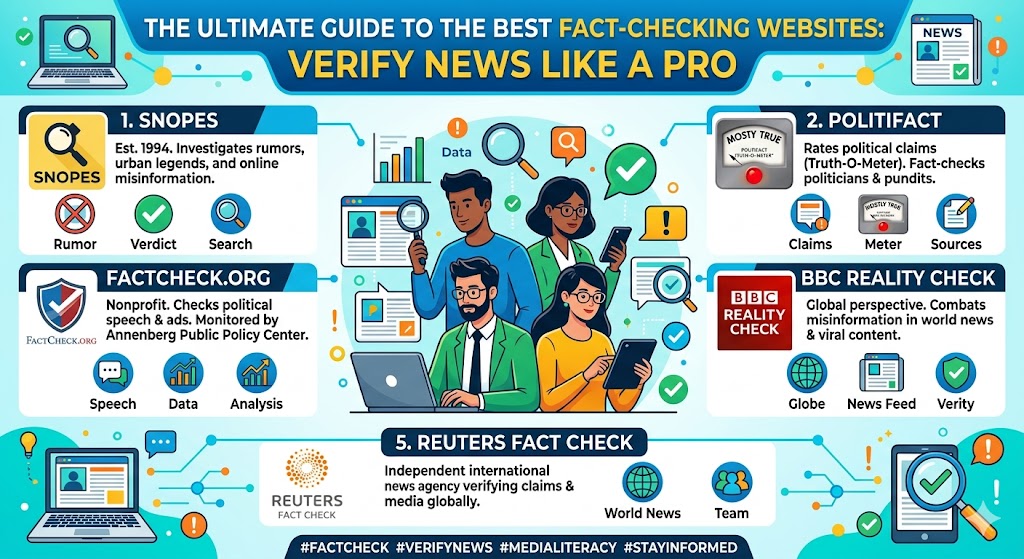
Here are the most consistently recommended and widely used ones (especially for English-language users), based on library guides, journalism resources, and fact-checking databases:
- Snopes (snopes.com)
- The internet’s oldest and most comprehensive resource for debunking urban legends, folklore, hoaxes, rumors, and viral misinformation. Excellent for social media claims and everyday “is this real?” questions.
- FactCheck.org
- A nonpartisan project of the University of Pennsylvania’s Annenberg Public Policy Center. Focuses on U.S. political claims, ads, speeches, and viral misinformation. Includes SciCheck for science-related claims.
- PolitiFact
- Runs the famous “Truth-O-Meter” rating system (True to Pants on Fire). Fact-checks statements by politicians, elected officials, and others. Part of the Poynter Institute.
- AP Fact Check (apnews.com/ap-fact-check)
- From the Associated Press (a major global wire service). Focuses on current news, viral claims, and “Not Real News” roundups. Highly regarded for neutrality and speed.
- Reuters Fact Check (reuters.com/fact-check)
- From Reuters, another top international news agency. Covers global stories, politics, and misinformation with rigorous sourcing.
- The Washington Post Fact Checker
- Award-winning team (led by Glenn Kessler) that rates claims with Pinocchios and provides in-depth analysis of politics and policy.
Other strong options
- BBC Verify / Reality Check (bbc.com) ? Great for international and UK-focused verification.
- Fact (fullfact.org) ? Independent UK organization focused on public debate and political claims.
- AFP Fact Check (factcheck.afp.com) ? Global coverage from Agence France-Presse.
Quick tips for effective verification
- Cross-check multiple sites — No single organization is perfect; reputable ones often link to each other or primary sources.
- Look for IFCN certification — It guarantees transparency in funding, methodology, and corrections.
- Use databases like the Duke Reporters’ Lab (reporterslab.org/fact-checking) for a full global map of hundreds of fact-checkers.
- For quick searches, many of these sites have strong search functions or allow you to submit claims directly.
These sites are free, regularly updated, and form the backbone of news verification for journalists, librarians, and the public. If a story isn’t covered yet, start with primary sources (official documents, videos, data) and reliable wire services like AP or Reuters themselves.