• Skip to main content
  • Skip to primary sidebar
  • Skip to footer

securitywing

wing

AI Without the Risk: How to Build Simple, Smart Guardrails for Your Team

Artificial Intelligence (AI) tools are landing on everyone’s desk faster than almost any technology in history. Employees are using AI to write emails, draft code, summarize long documents, and analyze data.

While AI opens up massive opportunities, it also brings brand-new risks: confidential company data getting leaked, AI making confident mistakes (“hallucinations”), or unfair biases slipping into key business decisions. [Read more…] about AI Without the Risk: How to Build Simple, Smart Guardrails for Your Team

From Vectors to Context: How Transformers Learn Through Attention and Self-Supervision

When I first started learing about transformer I found a couple of concepts were the key to understand the transformer model properly and those are wordembedding or vectorization of text, attechteion mechanism, multi head attention, self-supervised learning. In this post I have tried to explain how they are linked together and how they form the build blocks of the transfomer model.

These ideas are linked because they form the core of how a Transformer language model learns from text and uses context.

Here is the big picture:

Text > tokens  >vectors > multi-head attention > contextual representations ? predictions

[Read more…] about From Vectors to Context: How Transformers Learn Through Attention and Self-Supervision

Run AI Embeddings Locally: Turn Text into Vectors Without the Cloud

Using the frontier models to generate vectors for semnatic search might be expensive for the beginner who wants to learn about vector search and create embedding using low power laptops or PC(Windows). This posts discuss about a few simple but useful techniques to vectorize texts for semantic searches. [Read more…] about Run AI Embeddings Locally: Turn Text into Vectors Without the Cloud

The Ultimate Guide to the Best Fact-Checking Websites: Verify News Like a Pro

The top sites for verifying news or any misleading information are independent fact-checking organizations that investigate claims, viral stories, rumors, and political statements using transparent methods, original sources, and corrections when needed. Many adhere to the International Fact-Checking Network (IFCN) Code of Principles, a global standard for nonpartisanship, transparency, and accuracy (over 170 organizations worldwide are verified signatories).top fact checking websites

[Read more…] about The Ultimate Guide to the Best Fact-Checking Websites: Verify News Like a Pro

Python Class Explained for Beginners

A solid understaing of Python class is essential for the beginners who are planning to build complex soution using Python.Here in this post we weill discuss the basics of Python classes, inheritanfce and decoration using smaple codes with easy to understand explanation.

What is Python Class?

Python ClassesA class in Python is a blueprint for creating objects. It defines attributes (data) and methods (functions) that the objects created from the class will have.Take a look at the basic syntax of python class given below:

class Dog:
    def __init__(self, name, age):  # Constructor
        self.name = name           # Instance attribute
        self.age = age             # Instance attribute
    
    def bark(self):                # Instance method
        print(f"{self.name} says Woof!")
    
    def get_older(self, years):
        self.age += years
  • class Dog: defines a new class named Dog.
  • __init__ is a special method called the constructor. It runs when you create a new object.
  • self is a reference to the current instance of the class (required as the first parameter in instance methods).
  • You create an object (instance) like this as shown below:
my_dog = Dog("Buddy", 3)
my_dog.bark()         # Output: Buddy says Woof!
print(my_dog.age)     # Output: 3
my_dog.get_older(2)
print(my_dog.age)     # Output: 5

MethodsMethods are functions defined inside a class. There are three main types:

  1. Instance methods (most common)
    • Take self as the first parameter.
    • Can access and modify instance attributes.
  2. Class methods
    • Take cls as the first parameter.
    • Decorated with @classmethod.
    • Operate on the class itself, not instances.
    class Dog:
        species = "Canis familiaris"  # Class attribute
        
        @classmethod
        def get_species(cls):
            return cls.species
  3. Static methods
    • Don’t take self or cls.
    • Decorated with @staticmethod.
    • Behave like regular functions but belong to the class’s namespace.
    class Dog:
        @staticmethod
        def is_adult(age):
            return age >= 2
Method ChainingMethod chaining is a technique where multiple methods are called in a single line on the same object, making code more concise and readable (especially for builder patterns or fluent interfaces).To enable method chaining, each method must return the instance (self) (or another object that supports further chaining).Example without chaining:

class Car:
    def __init__(self):
        self.speed = 0
        self.color = "white"
    
    def set_speed(self, speed):
        self.speed = speed
    
    def paint(self, color):
        self.color = color

my_car = Car()
my_car.set_speed(100)
my_car.paint("red")
print(my_car.speed, my_car.color)  # 100 red

Example with method chaining:

class Car:
    def __init__(self):
        self.speed = 0
        self.color = "white"
    
    def set_speed(self, speed):
        self.speed = speed
        return self  # ? Important for chaining
    
    def paint(self, color):
        self.color = color
        return self  # ? Important for chaining

my_car = Car()
my_car.set_speed(100).paint("red")  # Chain the calls
print(my_car.speed, my_car.color)    # 100 red

You can chain as many methods as you want:

my_car.paint("blue").set_speed(200).paint("green")

Real-world examples of method chaining in Python:

  • Strings (immutable, so they return a new string):
    "  hello world  ".strip().upper().replace("WORLD", "PYTHON")
    # ? "HELLO PYTHON"
  • pandas DataFrames (very common):
    df.query("age > 30").sort_values("name").drop_duplicates()
  • Requests library (some methods return self):
    session.headers.update({...}).timeout(10).verify(False)

Key points for enabling chaining:

  1. The method should modify the object in place.
  2. The method must return self at the end.
  3. Avoid methods that naturally return something else (like len() or computations) unless you intentionally want to break the chain.

Summary

  • Classes define objects with attributes and behavior.
  • Methods are functions inside classes; instance methods use self.
  • Method chaining makes code fluent and readable by having each method return self.

This pattern is widely used in Python libraries to create clean, expressive APIs.

[Read more…] about Python Class Explained for Beginners

H-1B Visas: The Hidden Danger of Single-Country Dominance

The H-1B visa program allows U.S. employers to hire foreign workers in specialty occupations, with an annual cap of 85,000 new visas (65,000 regular + 20,000 for advanced U.S. degrees). Unlike employment-based green cards, which have a strict 7% per-country limit causing massive backlogs for high-demand nations, the H-1B program currently has no per-country cap. This means visas are allocated via a lottery without nationality restrictions. In practice, however, approvals are heavily skewed: In FY 2024, Indian nationals received about 71% of approvals (over 283,000 out of roughly 400,000 total approvals, including renewals), with China in second place but far behind. This dominance reflects India’s large pool of STEM graduates and strong ties to U.S. tech/IT firms. Risks if H-1B Visas Were Effectively Allocated to One Specific CountryAllocating nearly all (or officially limiting to one) H-1B visas to a single country—whether through policy changes or unchecked dominance—would pose several significant risks:H-1B-Visas-The-Hidden-Danger-of-Single-Country-Dominance [Read more…] about H-1B Visas: The Hidden Danger of Single-Country Dominance

AI Ethics and Security: What You Need to Know

This post explores the interplay between artificial intelligence (AI), ethics, and information security. As AI becomes increasingly pervasive and processes vast amounts of personal data, strong security controls are essential to prevent misuse and to uphold ethical boundaries.

Before implementing any AI initiative within an organization, it is important to highlight historical concerns around AI ethics, the significant overlap between ethical and security responsibilities, and the need for clearly defined roles and close collaboration among stakeholders. These elements are critical for addressing risks such as privacy violations, data leakage, and unauthorized access.AI Ethics and Security-What You Need to Know [Read more…] about AI Ethics and Security: What You Need to Know

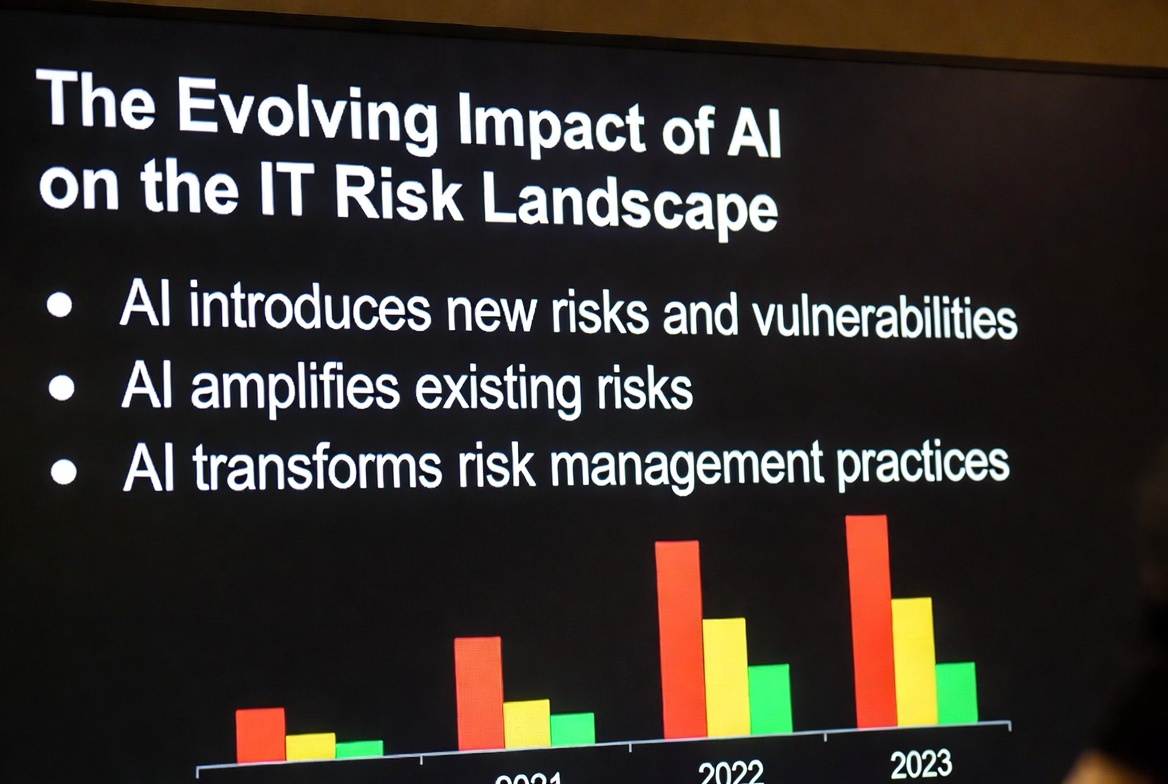
The Evolving Impact of AI on the IT Risk Landscape

This post explores how artificial intelligence (AI) is transforming industries while introducing significant new risks that extend beyond traditional IT risk management. Here we will foucus on AI’s “black box” nature, rapid adoption, and unique challenges (e.g., bias, privacy issues, and emergent behaviors) require organizations to adopt enhanced risk management strategies, including AI-specific controls, governance structures, and legal compliance measures. Relying solely on acceptable use policies is insufficient; instead, a “reasonable care” approach, informed by legal standards like the business judgment rule, is essential to mitigate liabilities and ensure ethical deployment. The piece emphasizes the need for ongoing inventories, risk assessments, and tailored life cycles for AI systems, concluding that organizations must evolve their practices to handle AI’s systemic impacts responsibly.The Evolving Impact of AI on the IT Risk Landscape [Read more…] about The Evolving Impact of AI on the IT Risk Landscape

NIST Incident Response Phases Explained-Special Publication (SP) 800-61 Revision 3

The NIST incident response lifecycle has evolved over time. In the latest guidance from NIST Special Publication (SP) 800-61 Revision 3 (published in 2025), it is integrated with the NIST Cybersecurity Framework (CSF) 2.0 to emphasize a continuous, risk-management-oriented approach rather than a strictly linear process.

This contrasts with the previous Revision 2 model, which outlined four discrete phases:

  1. Preparation;
  2. Detection and Analysis; Containment,
  3. Eradication, and Recovery; 
  4. Post-Incident Activity.

[Read more…] about NIST Incident Response Phases Explained-Special Publication (SP) 800-61 Revision 3

UK’s Digital Guardians: The Key Organizations Watching Over Social Media Content

There are several organizations in the UK that monitor social media content, primarily for regulatory, safety, or enforcement purposes related to harmful, illegal, or misleading material. These include government regulators, charities, and law enforcement bodies.You will usefel contents and guidance in those organizaiton’s website and can contact for help or guidance. Here’s a breakdown of the main ones:organization watching over social media [Read more…] about UK’s Digital Guardians: The Key Organizations Watching Over Social Media Content

Next Page »

Primary Sidebar

Please help us sharing

Categories

  • Artificial Intelligence
  • AWS
  • Basics
  • Containers
  • Cryptocurrency
  • Cyber
  • Cyber Insurance
  • Internet Security and Safety
  • IS Audit
  • IT Security Exams
  • Law & Human Rights
  • Network Security Tips
  • Off Track
  • Social Media Governance
  • Tech Comparisons
  • Tech Stack Suitability
  • Telecom
  • Tutorial

CISSP Sample Test

Take a CISSP Sample Test

CISA Sample Test

CISA IT governance Sample test

Please Follow Us

Contact us for Ads

Go to Contact Form

Search

Footer

Copyrights

Protected by Copyscape Duplicate Content Detection Software

Securitywing.com reserves the copyrights of all of its published articles.No contents of this site is permitted to be published to anywhere else in the Internet.If any contents are found in any other websites, securitywing reserves the rights to file a DMCA complaint. But you have the right to use the link of any relevant article of this site to point from your website if you consider that it might improve the quality of your article.

Tags

antivirus audit AWS backup browser check cisco cloud computer cyber data database ddos email encryption firewall home hsrp ids internet it kubernetes linux load balancing malware network protection putty risk router security security tips server social media ssh SSL tools virus vpn vulnerability web webserver website windows wordpress